
Organized retail crime has reached a scale that changes how retail leaders must think about security. U.S. retailers lost about $9 billion in retail merchandise to organized retail crime in 2025, while retail crime loss increased 9% from the previous 12 months, according to the ICSC analysis of organized retail crime. The loss is serious, but the operating model behind it matters even more. Criminal groups now combine store theft, phone scams, ecommerce fraud, returns abuse, and cargo theft.
That model defeats a security program built around cameras and guards alone. Effective prevention must begin where the theft becomes physically possible, especially at shopping trolleys, entrances, exits, and transaction-control points. Surveillance still has a role, but prevention works better when the store infrastructure can block an unauthorised event without asking an employee to confront a group.
Table of Contents
The Scale of Organized Retail Crime Today
Concentrated losses require a different response
How Organized Retail Crime Rings Operate
The theft continues after the exit
Business Impacts Beyond Inventory Loss
The hidden operating bill
Legal and Regulatory Framework for Retailers
Set clear boundaries for intervention
Preserve evidence that investigators can use
Comparing Prevention Approaches and Their Effectiveness
What each approach does well
Infrastructure-Level Solutions That Stop Theft at the Source
Start with the physical route
Building Your Comprehensive ORC Prevention Strategy
Build the program in practical layers
Measure control quality, not just loss
The Scale of Organized Retail Crime Today
Retailers reported an 18% increase in the average number of shoplifting incidents per year in 2024 compared with 2023. Threats or acts of violence during shoplifting or theft events also rose 17% over the same period, according to the National Retail Federation's 2025 industry findings.
The figures point to two linked pressures: more incidents and greater risk when employees or security personnel intervene. ORC now operates across physical stores, returns, ecommerce, logistics, and resale channels. A store event can therefore become an employee-safety, customer-safety, and operational-continuity problem.
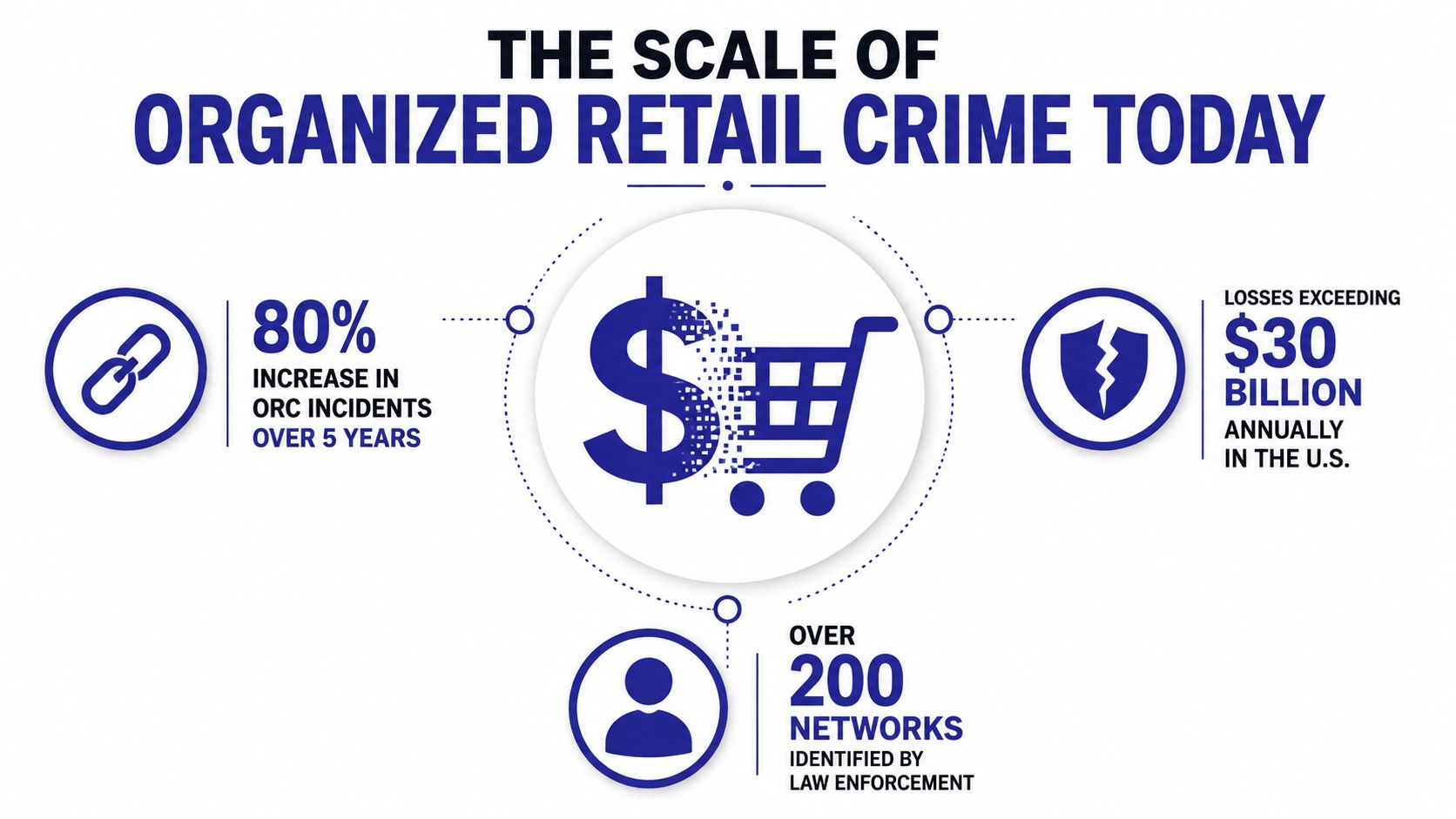
Concentrated losses require a different response
Organized retail crime differs from opportunistic shoplifting in both coordination and financial effect. One industry analysis found that 10% of offenders accounted for 68% of the total value of stolen merchandise, according to the ICSC report on ORC and retail shrink. A small number of repeat offenders can therefore drive a disproportionate share of losses through coordinated crews and resale channels.
The National Retail Federation also reported that 50% of retailers saw an increase in repeat offender activity and a 40% increase in ORC-related shoplifting. Retailers need connected incident records, not isolated video reviews. The same people, vehicles, products, and methods may appear across locations and channels.
Long-term shrink data supports that pattern. In the United States, the estimated ORC share of shrink rose from 0.045% of sales in 2015 to 0.07% in 2020, while total shrink rose from 1.4% to 1.6% of sales. At a $3.1 trillion brick-and-mortar sales base in 2020, the ORC share represented roughly $2.1 billion in nationwide losses.
Small percentages still produce material exposure at retail scale. Prevention must begin at the physical points where theft becomes possible, including shopping trolleys, entrances, exits, payment areas, and transaction-control points. Cameras and guards support detection and response, but infrastructure can restrict movement or block an unauthorised event before staff face a confrontation.
For retailers assessing physical controls, systec's company information provides background on solutions for shopping trolleys and brick-and-mortar retail environments.
How Organized Retail Crime Rings Operate
Organized retail crime begins before a crew enters the store. One person studies the layout, product placement, trolley routes, staffed tills, self-checkout setup, and exit paths. Another tests customer-service procedures or identifies products that can be returned, resold, or moved quickly through informal channels.
The group assigns separate roles. A scout watches staff movement and operating routines. One or more people collect merchandise across repeated visits, while another handles transport. The people leaving the store may have no role in arranging resale, so a single incident rarely explains the full operation without connected information.
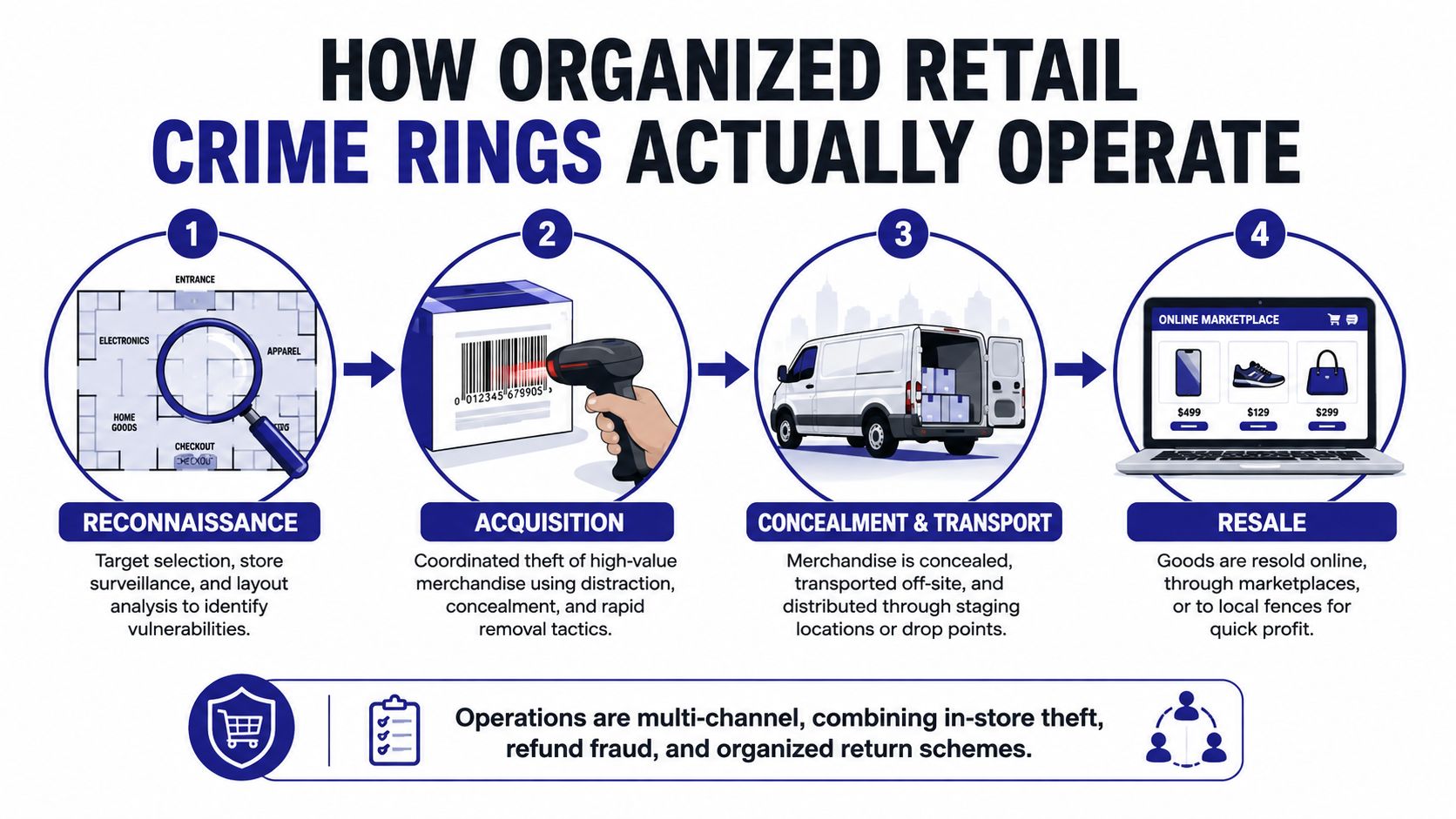
The theft continues after the exit
A grocery operation can be targeted through several channels at once. A crew may take high-demand personal-care products from physical stores, use a separate account or identity to seek a refund, and publish legitimate-looking listings on an online marketplace. Another participant may contact customer service with a prepared explanation intended to trigger a replacement or credit.
The network may also exploit logistics. Merchandise can leave through a store exit, move through a vehicle, and later enter a resale channel. Phone scams and ecommerce fraud extend the attack beyond the sales floor. Supply-chain theft gives the group another route to inventory.
The National Retail Federation's organized retail crime overview reports that more than half of surveyed retailers saw ORC-linked increases in phone scams at 70%, digital and ecommerce fraud at 55%, shoplifting and merchandise theft at 52%, and cargo or supply-chain theft at 50%. The categories point to a connected criminal model rather than isolated shoplifting.
Operational rule: A theft investigation should follow the product, transaction, vehicle, account, and repeat method, not only the person seen crossing the exit.
A guard at the door cannot address the full operation. The guard may observe a pushout event, while the wider network remains hidden across returns, customer service, ecommerce accounts, and other stores. Retailers need shared case information and consistent evidence collection. They also need physical controls that interrupt the event before merchandise leaves, including controls at trolleys, entrances, and exits. Cameras and guards support detection and response, but infrastructure can reduce the opportunity before staff face a confrontation.
Business Impacts Beyond Inventory Loss
Inventory loss is the most visible ORC cost. The larger operating bill often appears in staffing, employee confidence, customer behaviour, insurance discussions, store hours, and management time. After a theft, staff may need to secure the area, document what happened, check inventory, assist affected customers, and support investigators. That work pulls people away from sales and routine operations.
Employee safety changes the prevention equation. Threats and violence connected with theft have risen, making confrontation a poor default response when employees are not trained or authorised to manage physical escalation. A guard or camera may help identify an incident, but neither removes the physical opportunity created by an uncontrolled trolley route or an open entrance.
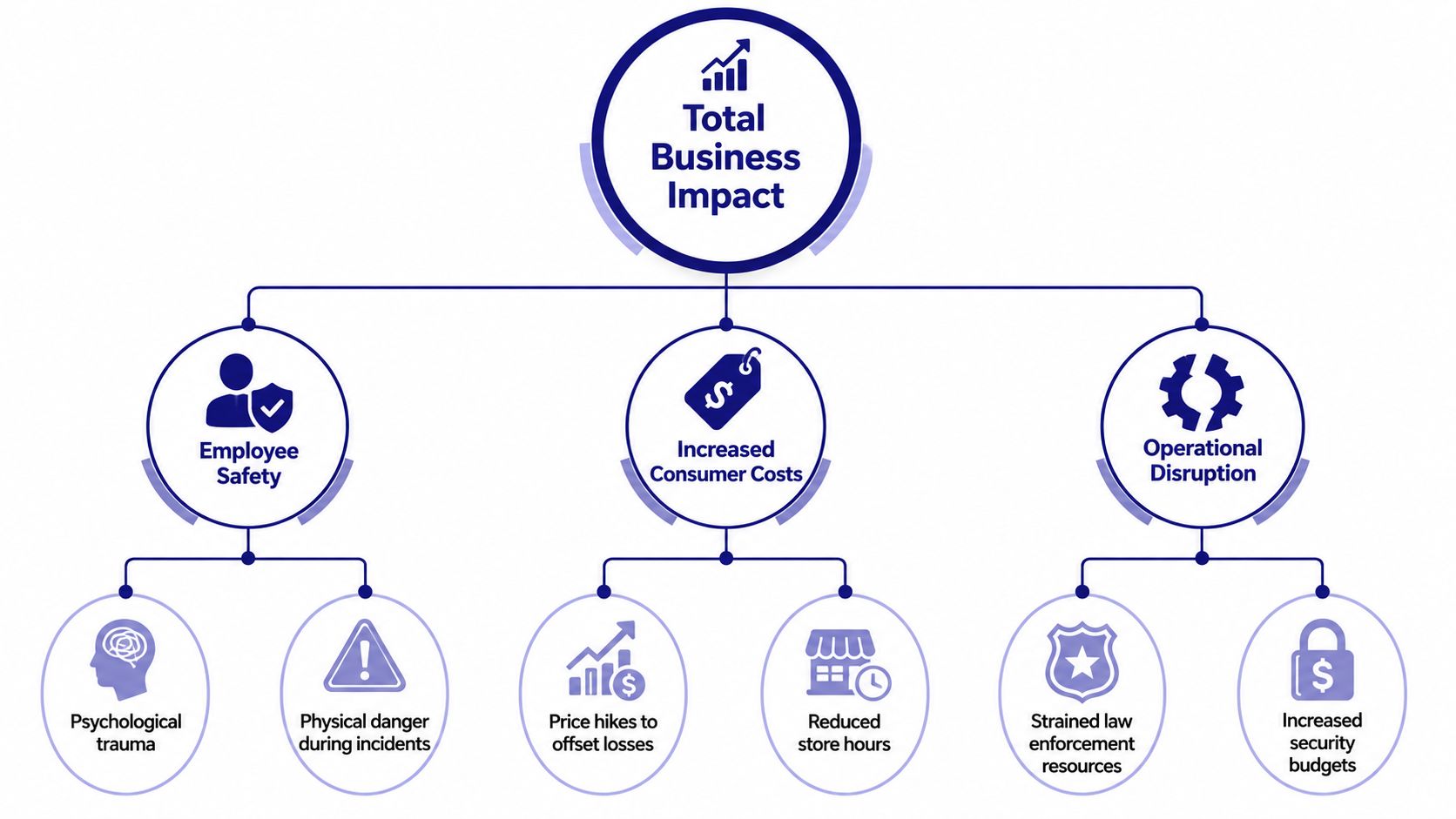
The hidden operating bill
Beyond merchandise loss, a violent incident can trigger unplanned overtime, damaged fixtures, insurance pressure, investigation work, and temporary disruption to trading. An impact review should track those costs alongside stock variance:
Employee safety: Fear, stress, or physical danger can reduce morale and make recruitment and retention harder.
Customer experience: Locked merchandise, blocked aisles, visible security procedures, and disrupted entrances make ordinary shopping less convenient.
Operational continuity: Repeated incidents consume manager time, interrupt replenishment, and create extra work for loss prevention, customer service, and finance teams.
Financial exposure: Retailers may need larger security budgets and may incur costs from fraudulent transactions, repairs, and evidence handling.
Reputation and liability: An aggressive intervention can create legal and reputational risk even when the original event involved theft.
Customer protection still requires restraint. Controls should protect merchandise without treating every shopper as a suspect. Automated trolley controls and intelligent gates can reduce confrontation compared with constant manual observation, provided staff explain the systems and they preserve normal customer flow. Starting with entrances and trolleys also addresses the physical movement that surveillance only records.
Cash and valuables require a separate control layer in stores where handling creates added exposure. Retailers can review systec's SmartSafe solution alongside store-security procedures, while keeping the ORC program focused on physical movement, transaction integrity, and employee safety.
Legal and Regulatory Framework for Retailers
Retailers need a written response policy before an ORC incident occurs. The policy should reflect the jurisdiction's rules on detention, evidence, privacy, surveillance, trespass, and use of force. A procedure that seems reasonable in one location may create legal exposure in another.
Set clear boundaries for intervention
The first step is to define who can act and under what conditions. Employees should know whether they may approach a suspected offender, observe and report, request assistance, or participate in a detention process. Security personnel need the same clarity, including limits on physical contact and escalation.
Retailers should also establish a strict rule that merchandise protection never justifies unnecessary danger. If threats, weapons, vehicle use, or group violence appear, staff should follow emergency procedures and contact law enforcement rather than attempting a recovery.
Preserve evidence that investigators can use
A useful evidence process should cover:
Time and location: Record when and where the event occurred, including the relevant entrance, trolley route, till, or exit.
Product information: Preserve item descriptions, quantities, prices, serial identifiers where applicable, and inventory records.
Video and access data: Retain footage from approach, selection, transaction, exit, and vehicle movement when legally permitted.
Witness accounts: Capture factual statements promptly, without asking employees to speculate about motives.
Transaction records: Link returns, refunds, loyalty accounts, payment events, and customer-service contacts through authorised channels.
Law-enforcement handoff: Use a consistent package so investigators can assess repeat activity across locations.
Legal review should also cover data sharing. Retailers may need agreements governing what information can be shared with other stores, law-enforcement agencies, landlords, technology providers, and industry networks.
Policies must be trained, tested, and updated. Technology doesn't remove the need for legal judgement. It gives employees a safer way to manage routine controls, but the retailer still needs documented authority, escalation paths, retention rules, and a process for reviewing false positives or customer complaints.
Comparing Prevention Approaches and Their Effectiveness
Organized retail crime now moves across stores, online marketplaces, returns, and coordinated transport. That multi-channel activity makes a single control unreliable. Cameras reconstruct events, employees recognise unusual behaviour and support customers, and analytics connect transactions, returns, products, and locations. Each has a defined role, but none should carry the program alone.

What each approach does well
Approach | Main strength | Main limitation |
|---|---|---|
Surveillance | Creates evidence and supports investigation | Usually detects activity after the event has started |
Security personnel | Adds visible presence and can coordinate response | Coverage is costly, variable, and may create confrontation risk |
Product locking | Restricts access to selected high-risk goods | Can frustrate customers and shift theft to other products or channels |
Electronic article surveillance | Signals when protected merchandise passes a detection point | It depends on tagging, alarm response, and staff follow-up |
Data analytics | Connects repeated patterns across transactions and locations | Poor data quality or isolated systems reduce its value |
Infrastructure controls | Prevents unauthorised movement at a physical choke point | Requires site assessment, installation, and operational integration |
The practical divide is detection versus prevention. A camera can show that a trolley crossed an exit. A trolley-blocking system can stop that movement before the trolley reaches the car park. Guards can intervene, while automated controls reduce the number of confrontations requiring human judgement.
Retailers comparing broader programs can use this guide to cutting retail shrinkage in Australia for additional planning context. Match the control to the specific failure point. Trolley pushouts need blocking systems at the route, not just cameras recording the result. Test whether the control changes the event before expanding visible security.
A layered design connects physical infrastructure with people and systems. Surveillance supports evidence, analytics identify repeat patterns, training improves decisions, and entrance or trolley controls restrict unauthorised movement at the point of escape. Retailers can review relevant loss-prevention systems and product categories when assessing how these controls fit the wider program. The strongest comparison therefore considers where the theft begins, where staff can safely act, and whether the control still works when offenders shift products or channels.
Infrastructure-Level Solutions That Stop Theft at the Source
The strongest physical control acts before merchandise reaches the car park. Shopping trolleys create a specific risk because they can carry a large volume of goods and allow a rapid pushout. If the trolley can leave freely, staff may have only seconds to decide whether to intervene.
A trolley-blocking system changes that sequence. When a trolley attempts to leave without passing through the authorised checkout area, the system can block its movement automatically. That creates a non-contact intervention, protects employees from direct confrontation, and gives the store a defined event to monitor.
Start with the physical route
A deployment should begin with a site assessment, not a product demonstration. The assessment should map:
Trolley paths: Identify every route from sales floor to car park, side entrance, loading area, and public boundary.
Authorised exits: Confirm where paid customer movement should occur and how exceptional routes are handled.
Infrastructure constraints: Review flooring, gate geometry, power, connectivity, weather exposure, and maintenance access.
Customer flow: Test how families, mobility devices, deliveries, and legitimate large purchases move through the site.
Escalation design: Define what staff see, who receives alerts, and how the store handles a blocked trolley.
Entrance controls address a related weakness. An intelligent gate can validate barcodes, detect manipulation attempts, regulate customer flow, and prevent unauthorised passage. Sensors that recognise people and obstacles help the gate respond safely, while light and audio guidance can explain normal use without requiring staff to stop every customer.
Commercial security systems for retail can provide useful context when integrating entrance controls with cameras, alarms, access management, and monitoring. The key is interoperability. A gate that operates separately from store processes may create workarounds, while a connected system can support remote configuration, event review, and consistent operating rules.
Retailers assessing this model can examine SmartGate as an example of an intelligent entrance and exit system designed to connect customer-flow management with loss prevention. The right solution should be tested during busy periods, reviewed for false blocks, and measured against customer complaints, staff interventions, and incident records.
Building Your Comprehensive ORC Prevention Strategy
A workable ORC program begins with the store, not a generic corporate checklist. Each location has different entrances, trolley routes, product exposure, staffing patterns, customer flows, and relationships with local law enforcement. The assessment should identify where merchandise becomes vulnerable and where employees face the greatest pressure to intervene.
Build the program in practical layers
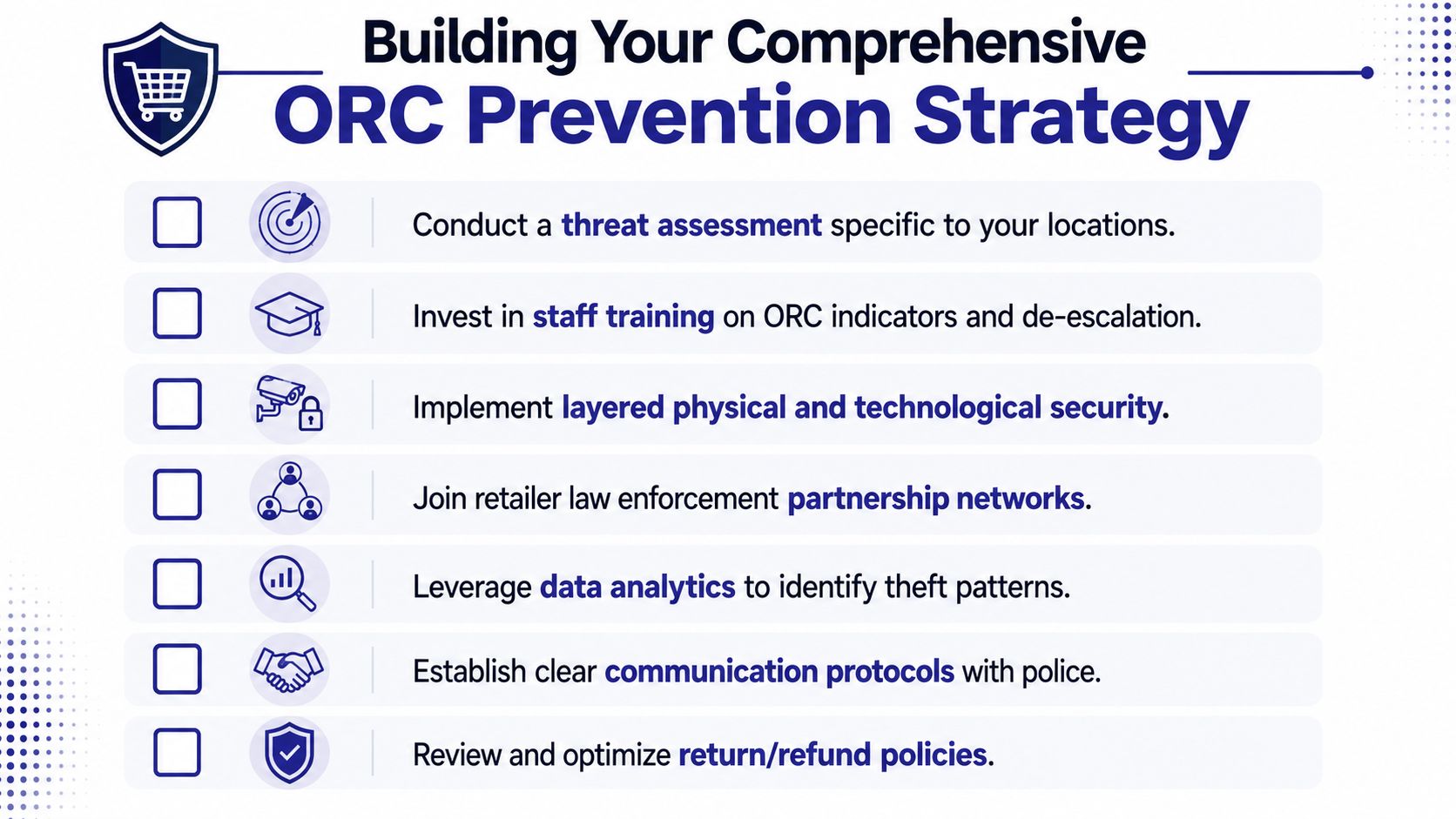
Start with a threat assessment that combines incident reports, inventory discrepancies, return activity, customer-service exceptions, and observations from store teams. Then prioritise controls at the points where a small intervention can prevent a larger event.
A strong operating plan should include:
Threat assessment: Map locations, routes, products, transaction types, and repeat methods.
Staff preparation: Train employees to recognise indicators, preserve evidence, communicate clearly, and de-escalate.
Physical controls: Secure trolley exits, entrances, high-risk merchandise, and other predictable movement points.
Technology integration: Connect gates, cameras, transaction records, alerts, and remote monitoring where appropriate.
External coordination: Establish clear contacts and information-sharing procedures with law enforcement and retail partners.
Analytics: Review recurring people, vehicles, products, refunds, accounts, and locations instead of isolated incidents.
Policy governance: Test return, refund, detention, privacy, and escalation rules with legal and operational stakeholders.
Measure control quality, not just loss
A useful review tracks whether controls operate as intended. Management should examine blocked or unauthorised exit events, employee interventions, false alarms, customer complaints, equipment status, response times, evidence quality, and repeated incident patterns. These measures help distinguish a functioning prevention layer from a system that merely produces alerts.
Implementation should proceed in a controlled sequence. Test the highest-risk route first, train affected employees before activation, monitor normal customer behaviour, correct friction quickly, and then extend the design to comparable locations. A modular trolley-control option such as Smartloc can be considered within that broader assessment of physical loss-prevention needs.
Executive test: If a prevention system requires an employee to confront a coordinated group before it works, the design is incomplete.
Organized retail crime won't be reduced by one camera, one guard, or one policy change. Retailers need connected intelligence, disciplined evidence handling, lawful procedures, and physical infrastructure that stops unauthorised movement at the source.
systec POS-Technology GmbH develops shopping-trolley and store-entrance solutions that support non-confrontational loss prevention, including controls for pushout theft and authorised customer flow. Retailers can review the systec POS-Technology GmbH portfolio and discuss how trolley, gate, and store IT requirements could fit into an ORC prevention strategy.
Resources
Related articles


Protect your Profit
We provide professional advice on shopping cart accessories and merchandise protection.