Retail theft is no longer a background nuisance. The National Retail Federation reported an 18% increase in the average number of shoplifting incidents per year in 2024 versus 2023, and threats or acts of violence during those events rose 17% over the same period NRF study on theft and violence. That matters because the loss is no longer just merchandise, it's staff safety, labor pressure, and the daily disruption that comes with recurring pushout attempts.
The stores that feel this most are the ones built for speed and open access, especially grocery, supermarket, DIY, and garden-center formats. Their biggest weakness isn't usually a missing camera. It's the gap between the checkout lane and the exit, where a trolley can be pushed out with very little friction and a lot of damage.
Table of Contents
The Rising Cost and Complexity of Retail Theft
Why the exit has become the pressure point
Auditing Your Store for Trolley-Based Theft Vulnerabilities
What to look for during the walk-through
How to separate one-off theft from a pattern
Comparing Trolley-Level Blocking Systems to Traditional Exit Controls
Implementing Smart Entrance and Exit Gates
Configuration that actually matters
Phased rollout across multiple stores
Leveraging Ergonomic Handles and Integrated Accessories for Loss Prevention
Small hardware changes that support better control
Why this matters for prevention planning
Measuring Success with the Right Loss Prevention KPIs
How to build a usable dashboard
Building a Future-Proof Retail Security Strategy
The Rising Cost and Complexity of Retail Theft

The latest NRF data changes the conversation. Retailers saw an 18% increase in average annual shoplifting incidents in 2024 versus 2023, and violence rose 17% in the same period NRF study on theft and violence. Earlier NRF research also showed that the average number of shoplifting incidents in 2023 was 93% higher than in 2019, while dollar losses from shoplifting were up 90% over that span NRF study on theft and violence. That is a clear sign that theft prevention has moved from a shrink problem to an operational risk problem.
Why the exit has become the pressure point
Theft in open-format retail is rarely about a single isolated act. The same store can face opportunistic grab-and-run behavior, repeat offenders, and organized groups that know exactly where the weak exits are. The practical problem is simple, if the store's controls sit too late in the customer journey, employees are left to react after the trolley is already moving.
Practical rule: the best control is the one that changes the offender's path before confrontation starts.
Source-level controls matter in high-traffic stores because they change the opportunity before the exit becomes the point of conflict. A smart entrance, a trolley blocker, or an automated passage control changes the route itself, which is where prevention is easiest to enforce. Cameras and extra staff still have a role, but they work best when they support a control that engages before the trolley crosses the threshold.
The scale of retail loss also justifies a layered approach. Industry reporting based on NRF-linked data estimated global retail shrink at $112 billion in 2023 retail theft statistics overview. In the U.S., shoplifting losses were estimated at about $45 billion in 2024 and $47.8 billion in 2025. In the U.K., Retail Economics and Thruvision estimated retail theft at £7.9 billion in 2023, equal to 1.7% of sales, with 59.5% attributed to customers and 40% to employees and organized crime combined retail theft statistics overview. Those figures are not abstract. They explain why small gains at the exit can matter across a chain.
For procurement teams, the takeaway is direct. Systems that only document theft are not enough anymore. Stores need controls that stop the trolley before it leaves the authorized flow, and they need them in a way that does not turn the front end into a confrontation zone. For retailers evaluating source-level options, a structured review of retail loss prevention systems is a practical place to start, especially when the store format depends on carts and open exits.
Auditing Your Store for Trolley-Based Theft Vulnerabilities
The fastest way to waste money is to buy equipment before the store has been mapped properly. A situational-crime approach starts with the crime pattern, then moves to the specific vulnerability, then selects the control that changes that vulnerability situational crime prevention guidance. That logic is especially useful for trolley-based theft, because the weak point is usually visible once the route from basket pick-up to exit is traced step by step.
What to look for during the walk-through
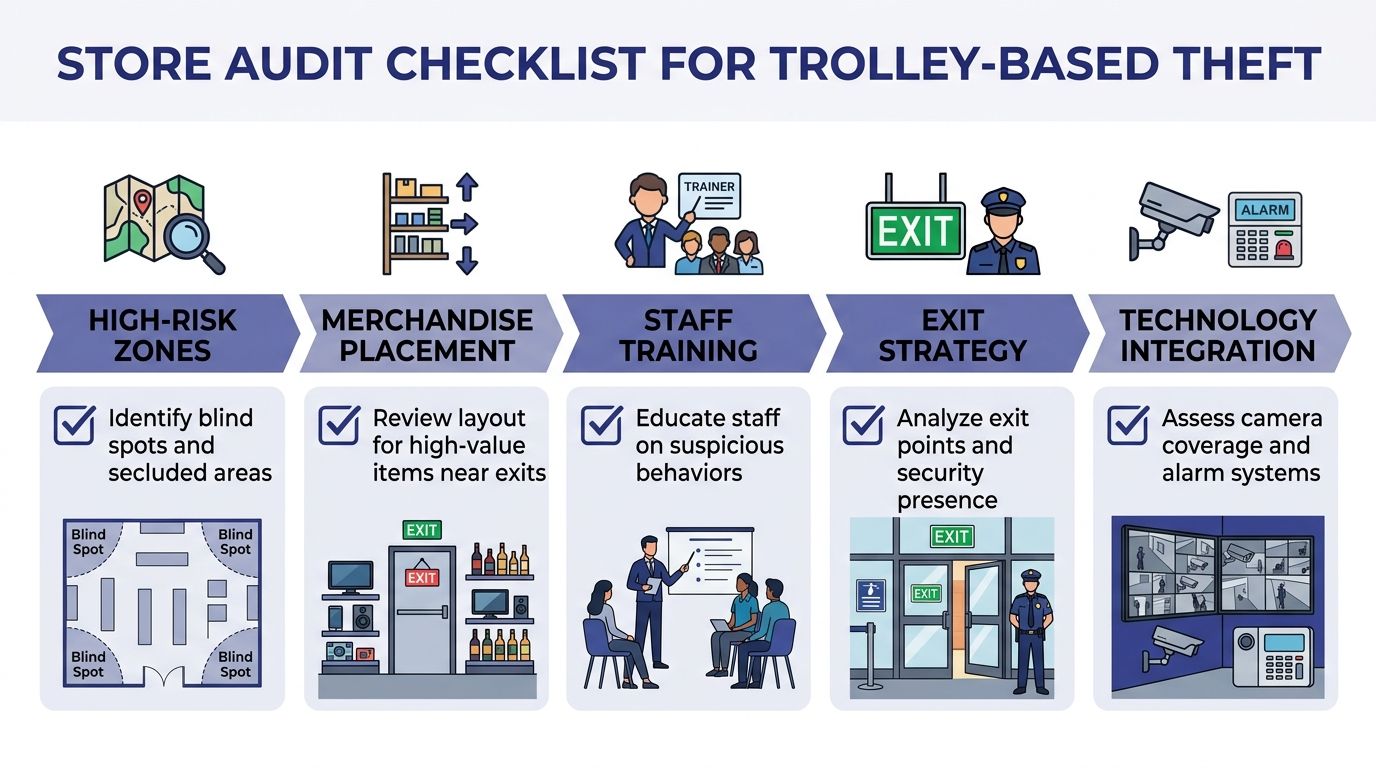
A practical audit should follow the customer's path, not the manager's office view of the store. Entry, merchandising, checkout, and exit all need to be watched as a single flow. The key question is not whether cameras exist, it's whether a loaded trolley can reach the exit without being forced into a meaningful control point.
High-risk zones: Identify blind spots, self-serve edges, and secluded corners where staff presence drops off.
Merchandise placement: Check whether easily carried high-value goods sit too close to the exit path.
Staff behavior: Watch whether employees greet, redirect, or observe from a distance.
Exit points: Test whether more than one route allows a trolley to pass with minimal friction.
Technology coverage: Verify whether current controls change access, or just record it.
That last point matters because visibility alone doesn't stop the movement of a trolley. The classic shoplifting experiment summarized by Clarke and colleagues found that electronic tagging produced a lasting decrease in shoplifting, while store redesign had a short-lived effect and a uniformed guard had no measurable benefit Clarke summary of shoplifting experiment. The lesson is not that guards or design never matter, it's that the control has to alter the offender's opportunity in a durable way.
How to separate one-off theft from a pattern
A store team should treat repeated pushout attempts differently from occasional opportunistic loss. Repetition usually points to an access problem, a staff response problem, or both. If the same exit, same daypart, or same trolley path keeps appearing in incident notes, the root cause is probably structural.
If the trolley route doesn't change, the loss pattern won't change either.
That's why the most useful audit output is a short list of physical and procedural gaps, ranked by how easily they can be exploited. Start with the exits that need staff confrontation to work, then the places where trolley movement is uncontrolled, then the layouts that make observation too late to matter. That sequence keeps the store focused on the points where prevention can happen before a pushout becomes a chase.
For retailers already reviewing cart-based controls, a dedicated trolley system such as Trolleymatic 2 fits naturally into this kind of vulnerability review because it addresses the point of exit rather than relying on observation alone.
Comparing Trolley-Level Blocking Systems to Traditional Exit Controls
Trolley-level blocking and conventional exit controls solve the same problem in different ways. One changes the trolley itself, the other manages the doorway. In stores with heavy cart traffic, that distinction matters because the wrong control can slow legitimate shoppers while still missing the person who is willing to walk through a gate, ignore a checker, or push past a weak front-end routine.
Criteria | Trolley Blocking Systems | Traditional Exit Controls |
|---|---|---|
Theft interruption point | Acts at the trolley level before exit | Acts at the doorway or after the trolley reaches the exit |
Staff confrontation risk | Lower, because the system can intervene without direct contact | Higher, because staff often need to challenge, verify, or stop the customer |
Throughput impact | Usually more targeted, because it only affects the trolley that triggers the rule | Can create bottlenecks if the gate or checker becomes the main choke point |
Operational fit | Works well where carts are central to the shopping journey | Works well where traffic is manageable and staff can support the control |
Maintenance and response | Best when tied to remote monitoring and clear system status checks | Often depends more on local staffing consistency and manual follow-up |
The strongest case for trolley blocking is safety and precision. If the system blocks at the cart, the employee doesn't have to step into a confrontation at the threshold. That matters because the NRF reported that violence during theft events rose alongside incident frequency NRF study on theft and violence. In a store where the risk of escalation is real, reducing human confrontation is a practical advantage, not a nice-to-have.
Traditional exit controls still have a role, but they work best when the store can support them with enough staff discipline and response consistency. If the front end is busy, a gate that depends on manual verification can become a bottleneck or a frustration point for honest customers. In that sense, conventional controls are often better at signaling policy than stopping movement.
The best procurement question is not which system looks stronger on paper. It's which one changes the path of a loaded trolley with the least staff friction. For many supermarket and garden-center layouts, that points to source-level blocking at the cart, with exit controls reserved for secondary verification or traffic management.
Implementing Smart Entrance and Exit Gates
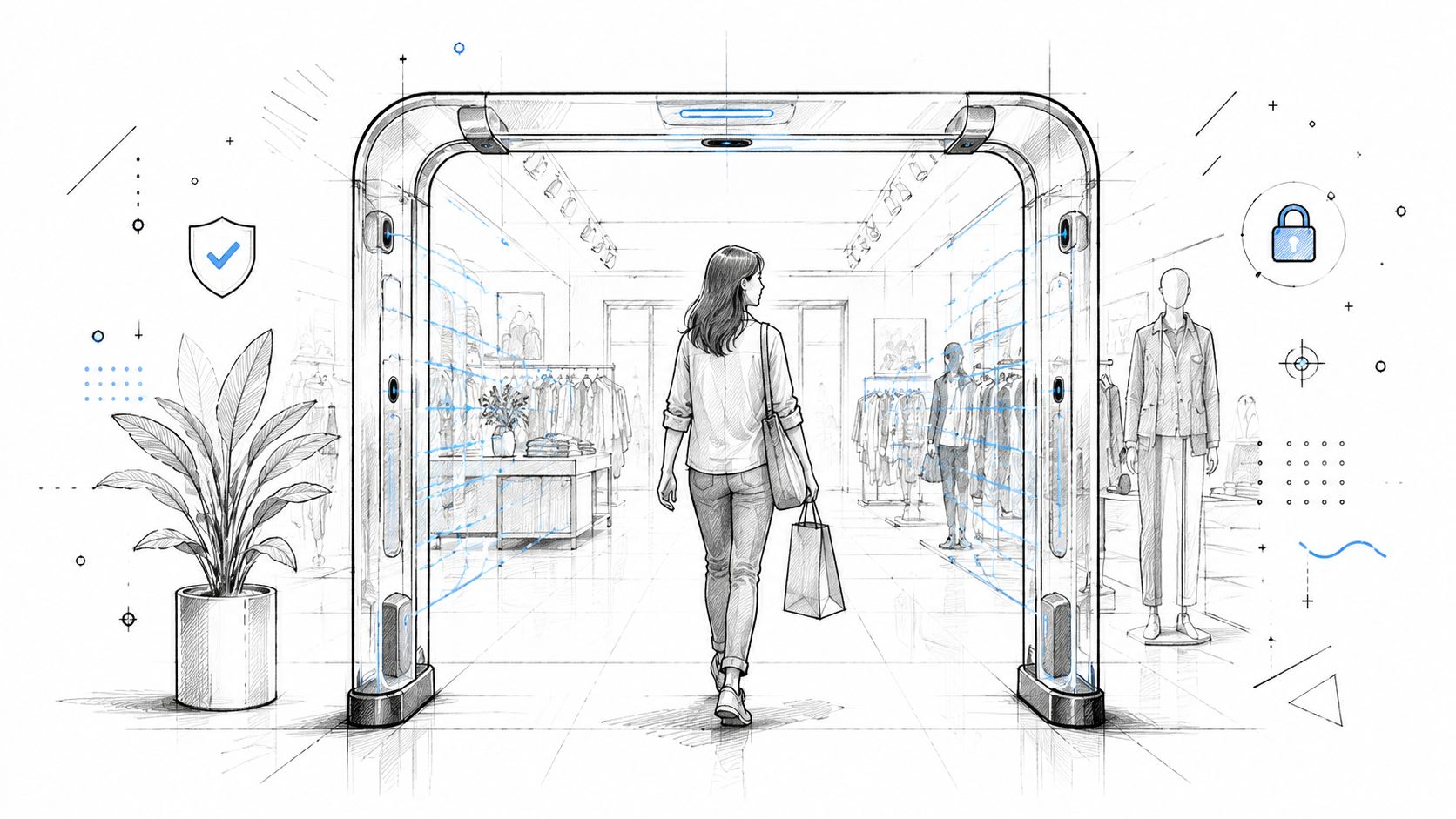
Smart gates work best when the store treats them as part of the operating flow, not as a stand-alone barrier. They need to recognize legitimate passage quickly, flag misuse reliably, and avoid turning every customer into a security event. That balance is what separates a useful front-end control from a piece of hardware that people complain about after the first week.
A practical rollout starts with the traffic pattern. High-volume stores need gate logic that supports normal movement first, then theft prevention second, because over-restrictive settings can create unnecessary friction. Remote access and centralized configuration are useful here, because gate behavior can be adjusted as incident data changes, rather than waiting for an on-site visit to correct a poor setup.
One procurement resource that helps teams compare installation trade-offs is compare gate installation costs UK, especially when a chain is weighing the front-end design impact against staffing and throughput.
Configuration that actually matters
The valuable settings are the ones tied to movement and misuse. Barcode validation helps stop unauthorized passage, anti-passback logic can reduce manipulation attempts, and sensor coverage can detect people and obstacles in the movement area. Those features matter more than flashy alerts, because they shape whether the gate prevents misuse or merely reacts after it has already happened.
A smart gate also needs staff training that is specific. Teams should know how the gate signals a problem, when to override it, and who reviews repeat events. If the store can't explain the signal, it can't trust the signal.
The video below is useful for teams that want to see how a customer-flow gate fits into a retail entrance. It's most helpful after the hardware is selected, because the primary challenge is not the concept, it's the daily operation.
Phased rollout across multiple stores
A chain rollout should begin with the most troublesome format, not the easiest one. Stores with heavy trolley use, repeated exit issues, or weak sightlines should get the first deployment, then the team can compare how the gate performs across different floor plans. That keeps the project grounded in actual incident reduction instead of aesthetic uniformity.
For IT teams, the important part is integration. Smart gates only stay useful if they can connect to existing store systems and central service tools, which is why a platform such as SmartGate fits a broader loss-prevention stack rather than sitting outside it.
Leveraging Ergonomic Handles and Integrated Accessories for Loss Prevention
Loss prevention doesn't start at the exit only. It starts where the shopper takes control of the trolley, because that's the first point where the store can shape behavior without creating pressure or confrontation. An ergonomic handle, a smartphone holder, and a child safety belt may sound like convenience features, but they also create cleaner touchpoints and a more observable customer journey.
Small hardware changes that support better control
An ergonomic handle helps the trolley stay manageable when it's fully loaded, which reduces the kind of awkward pushing that makes carts harder for staff to track. An antistatic handle also cuts down on avoidable complaints, which matters because frustrated shoppers are more likely to ignore guidance and rush the exit. That's not a theft statistic, it's operational reality.
A universal smartphone holder is more useful than many teams expect. It keeps the device visible and in reach, which supports retailer apps, self-scanning, product information, and mobile payment during the trip. Those tools increase transaction visibility and create another point of engagement before the customer reaches the exit.
The child safety belt serves a different purpose. It keeps families organized inside the trolley, which reduces distractions and lowers the chance that a busy adult will drift straight past the normal shopping flow. In stores that want a calmer front end, that matters.
Operational insight: accessories that improve the shopping trip can also make behavior easier to read.
Why this matters for prevention planning
These features are not standalone theft controls. Their value comes from how they fit into a broader system of source-level prevention, store flow, and fewer unnecessary interventions. A trolley that is comfortable, visible, and digitally connected is easier to monitor than one that is treated as a generic metal basket.
The main mistake is treating these accessories as branding items. They are better viewed as control points that support the rest of the loss-prevention stack. When the handle system, holder, and safety belt are integrated into everyday shopping, the store gets more data, fewer complaints, and a cleaner path to the exit.
For operators evaluating accessory-based controls, systec POS-Technology GmbH offers trolley handle systems, smartphone holders, and child safety components that can be used as part of that source-level approach.
Measuring Success with the Right Loss Prevention KPIs
Loss prevention teams that only track shrink are working too late. Shrink tells the story after the fact, but the control system needs measures that show what happened at the exit, how fast the system reacted, and whether staff had to step in. The right KPI set should connect operational control with actual incident handling.
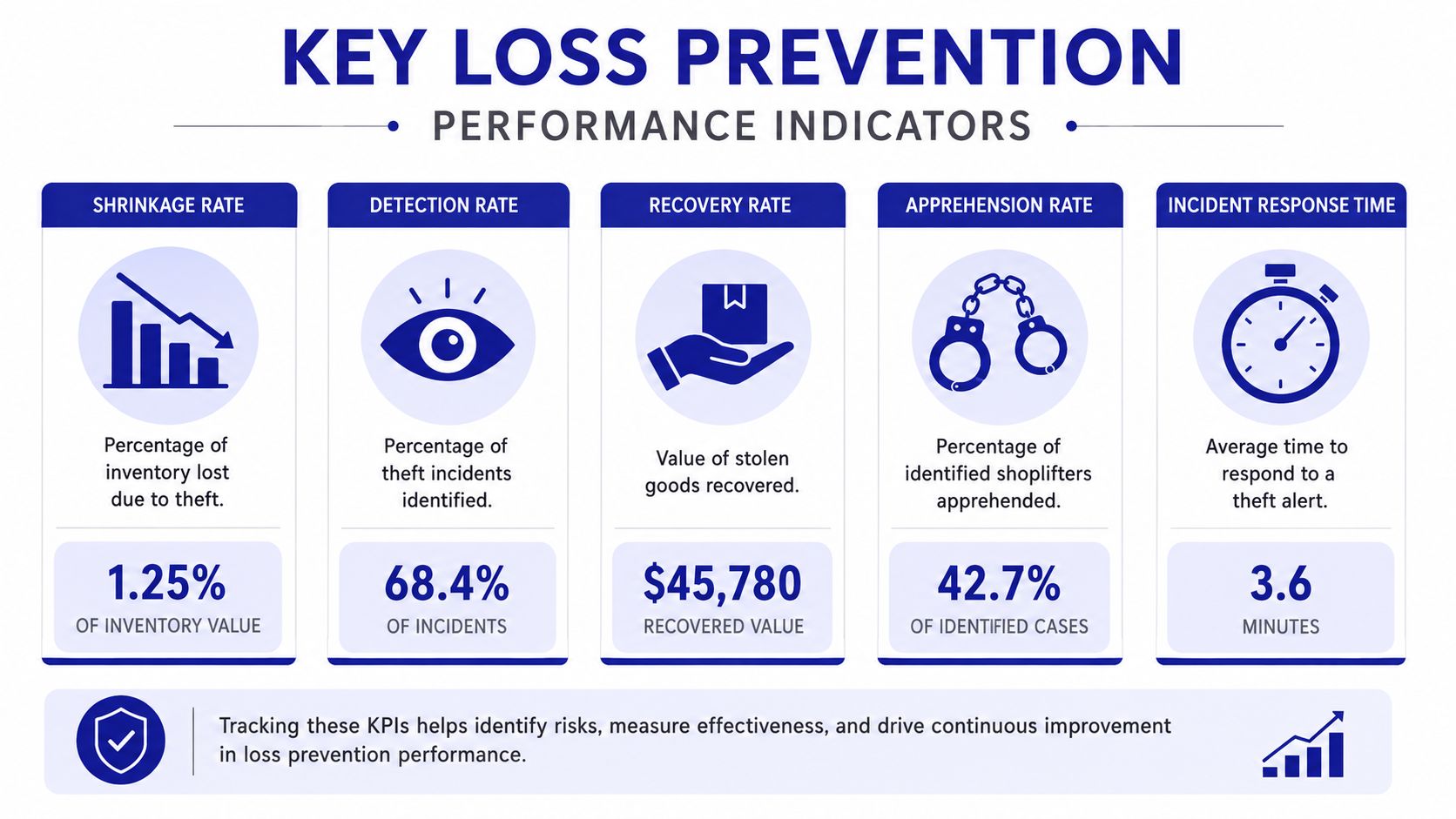
The most useful metrics are straightforward:
Shrinkage rate: the percentage of inventory lost to theft and other shrink.
Detection rate: the share of incidents identified by staff, systems, or both.
Recovery rate: the value of stolen goods recovered after an incident.
Apprehension rate: the share of identified shoplifters apprehended under policy and law.
Incident response time: the average time between alert and action.
Those measures work best when they're tracked together, not in isolation. A system can look good on paper if detection rises, but if response time is too slow, the theft still leaves the building. That is precisely why the FMI Supermarket Security and Loss Prevention report is useful as a benchmark, because it showed food retailers using a mix of CCTV, POS monitoring, and employee hotlines while reducing losses from theft and other shrink from 2.00% of sales in 2004 to 1.69% in 2005 FMI Supermarket Security and Loss Prevention report. The point isn't to copy that exact mix. The point is to measure whether the mix changes the outcome.
How to build a usable dashboard
The baseline should come from current store data, not a guess from head office. Once the store knows its normal incident pattern, it can track whether a new control is changing pushout frequency, reducing false alarms, or shortening the time between trigger and intervention. If a gate or trolley system causes frequent false alerts, that's a service issue, not a success story.
Metrics should measure movement, not just paperwork.
A good dashboard also needs one qualitative field, staff safety notes. If the system is improving shrink but increasing confrontation, the program is solving the wrong problem. The best controls reduce both loss and pressure on the people working the front end.
The cleanest test of any intervention is simple. If the store can show fewer incidents, less staff escalation, and faster response, the control is probably doing real work. If it only produces footage after the fact, it's a reporting tool, not a prevention tool.
Building a Future-Proof Retail Security Strategy
Retail theft is shifting toward more organized, more frequent, and more aggressive patterns, so the response has to shift too. Stores that keep relying on surveillance-heavy, reactive setups will always be one step behind the people testing the exits. The stronger path is source-level prevention, layered with smart entry control and operational data that can be adjusted store by store.
That means prioritizing the controls that change the trolley's route, the gate's behavior, and the staff's need to confront. It also means choosing systems that connect to store IT and can be tuned as incident patterns change, not locked into a static configuration. For teams comparing broad prevention options, a practical reference like how to stop shoplifting can help frame the wider mix of store controls, while the procurement decision still comes down to fit, flow, and safety.
A future-proof strategy is built in layers. Put the most frictionless control at the source, add smart entrance logic where traffic needs it, and measure the result with KPIs that reflect real operational change. That's the route that keeps the store open, the front end calmer, and the loss-prevention program useful when the threat pattern changes again.
systec POS-Technology GmbH develops shopping trolley and entrance control systems that support source-level theft prevention, ergonomic trolley handling, and store integration. For retail teams planning a practical rollout across carts, gates, and accessories, visit systec POS-Technology GmbH to review the available system options and fit them to the store format.
Prepared with Outrank app
Resources
Related articles


Protect your Profit
We provide professional advice on shopping cart accessories and merchandise protection.