
Most advice about grocery store equipment suppliers gets the first step wrong. It treats procurement like a price hunt, when the decision is whether a supplier can support store uptime, integration, and maintenance for years after the install crew leaves.
That matters in grocery because the installed base is huge and constantly renewing itself. FMI reports 45,575 supermarkets in the United States in 2024, and the average supermarket generated $668,377 in weekly sales in 2025, which creates a recurring modernization cycle instead of a one-time buildout market (FMI food industry facts). Suppliers that only compete on a low bid usually fall apart when stores need parts, service, firmware support, or retrofit help mid-cycle.
Table of Contents
Why Supplier Selection Is a Decade-Long Decision
The market is too large for one-off thinking
What that means for contracts
Total Cost of Ownership Beyond the Price Tag
Energy and maintenance shape the real bill
Watch for price-first designs
Technical Specifications That Actually Matter
Checkout and refrigeration need hard numbers
Build the spec sheet around use, not marketing
Evaluating Service Infrastructure and Support Models
Compare what happens after installation
Ask how the supplier handles real incidents
Compliance Certifications and IT Integration Readiness
Certifications matter because stores inherit the risk
Integration is now part of the spec
Building Your Supplier Evaluation Scorecard
Weight the criteria before the RFP goes out
Score what can be verified
Adapting Criteria for Different Store Formats
Different formats need different priorities
A simple way to weight the scorecard
Why Supplier Selection Is a Decade-Long Decision
A grocery equipment purchase looks clean on a bid sheet. A case, a gate, a checkout lane, a handle system. In a store, it becomes a long relationship with the supplier's parts team, service desk, product engineers, and firmware roadmap.
The cheapest quote often turns into the costliest choice. A supplier that cannot hold spare parts, answer service calls quickly, or support later integrations pushes the store into rushed repairs, emergency replacements, and workarounds that never appear in the original bid.
The market is too large for one-off thinking
The grocery sector is not a boutique niche. It supports 6.3 million people across grocery stores and food manufacturers, and Americans spent 5.0% of disposable income on food at home in 2024, which keeps pressure on chains to improve efficiency and control shrink while modernizing stores (FMI food industry facts). That mix pushes buying teams toward recurring equipment refreshes, not isolated purchases.
In practical terms, the supplier relationship should be judged like a store asset relationship. The question is not only whether the equipment works at delivery. The key question is whether the supplier can still support the asset when the store remodels, the POS stack changes, or the operations team wants to standardize across multiple locations.
Practical rule: if a supplier cannot explain how it supports a product after installation, it is not really selling an operating asset. It is selling a box.
A mature procurement team also checks whether the supplier has enough business depth to survive long replacement cycles. The National Grocers Association buyer guidance stresses supplier longevity, maintenance, and repair support because the wrong partner can look cheap at purchase and expensive every month after that.
What that means for contracts
A good contract does not stop at delivery terms. It defines who handles installation, how service is dispatched, what happens when a component fails, and how upgrades are managed across the rollout. That matters in multi-site chains, where one weak supplier can create repeated exceptions that eat field labor and district manager time.
Procurement should ask a simple question before any signature. If a store manager has a problem three years from now, who owns the fix? If the answer is vague, the supplier is not ready for grocery. For connected security and access-control equipment, a platform like Systec SmartSafe shows why integration readiness matters as much as the hardware itself.
Total Cost of Ownership Beyond the Price Tag
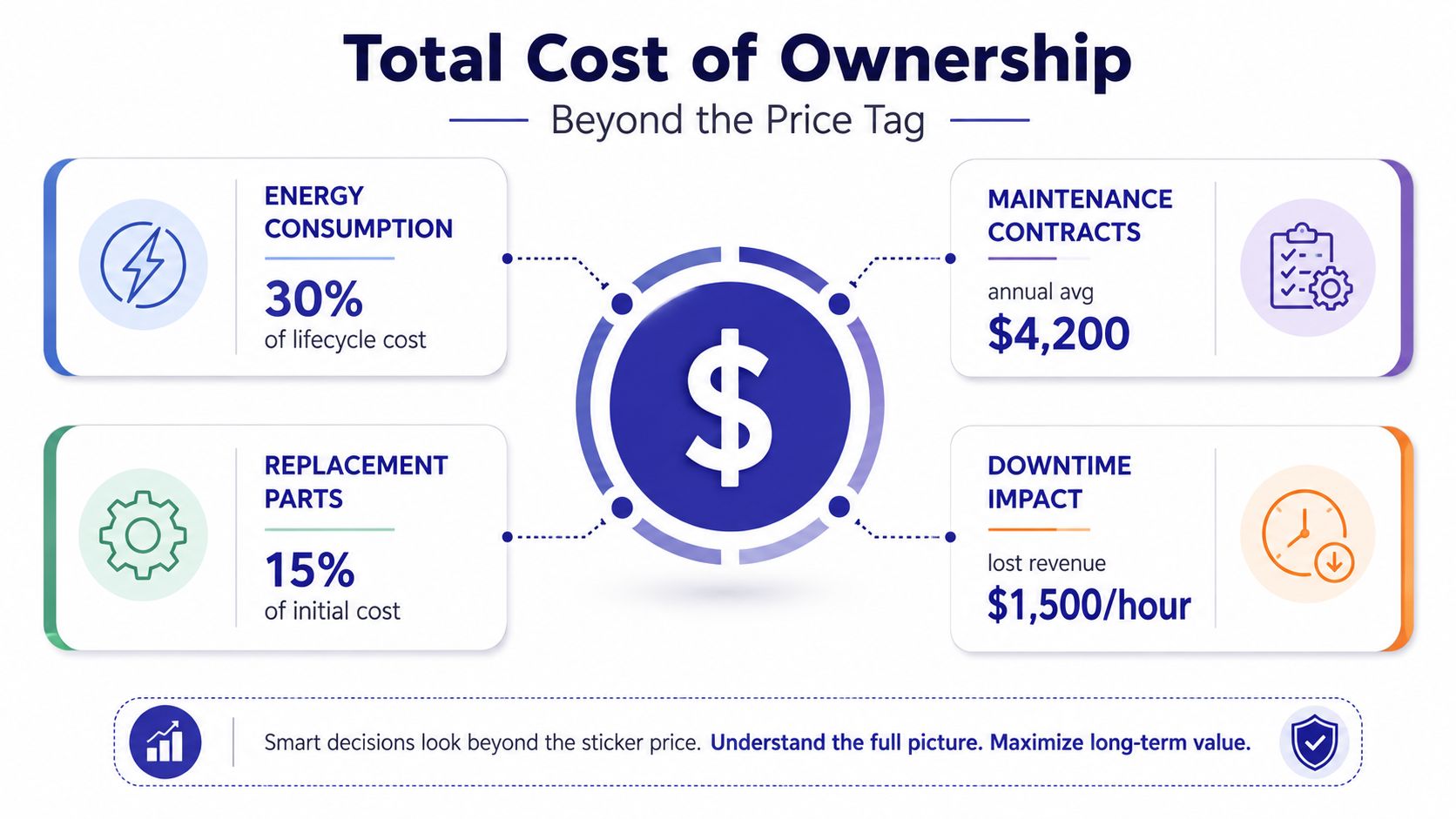
The lowest quote is often the easiest one to defend, and the hardest one to live with. Grocery equipment sits inside a facility cost structure where energy, maintenance, downtime, and replacement parts shape the actual bill over time.
Energy and maintenance shape the real bill
A DOE profile estimates that food stores use about 51 kWh of electricity per square foot annually, with up to 58% of consumption devoted to refrigeration. It also estimates that a typical grocery store spent $1.71 per square foot on facilities repairs and maintenance in 2020. Those figures make the trade-off plain, efficiency and serviceability affect operating cost every day, not just at purchase.
That is why buyers should ask vendors for lifecycle cost assumptions, not only a discount schedule. The right comparison is not just what a unit costs today, but what it will cost after service calls, parts replacement, energy use, and planned refreshes are added in.
A procurement file should separate costs into clear buckets:
Energy use: compare operating efficiency, not brochure claims.
Maintenance labor: ask who performs work, how often, and at what response level.
Replacement parts: verify that common wear items are stocked or easy to source.
Downtime exposure: estimate the operational impact if the unit fails during peak hours.
End-of-life handling: confirm disposal, recovery, or swap-out obligations.
Watch for price-first designs
The clearest warning sign is a supplier that avoids lifecycle detail. If a vendor only discusses purchase price and footprint, it is usually optimizing for the sale, not the store. The same problem shows up when a proposal leaves out install time, service access, or the path for replacing parts in the field.
For security-related store hardware, some operators include integrated solutions like systec POS-Technology GmbH's SMARTSAFE belt system in the lifecycle review because the cost of a control point includes the hardware and the support model around it.
A serious comparison asks what happens in year seven, not just week seven. That is when a cheap purchase usually shows up as a facilities issue.
Technical Specifications That Actually Matter
Catalog sheets are often written to look reassuring. Procurement teams need operating benchmarks instead. Without them, a supplier can pass a visual review and still fail once the equipment is in service.
Checkout and refrigeration need hard numbers
Checkout equipment should be judged by how it performs under store traffic, not by how clean the render looks on a proposal. For conveyor checkouts, that means verifying load capacity, noise, and belt speed against the way your front end runs. One checkout specification example lists a belt load capacity of about 100 kg, operating noise around 58 dB, and a motor speed near 0.15 m/s. Those numbers matter because basket-to-trolley transfers put strain on weak belts, loud equipment distracts cashiers, and slow movement creates a queue at the front end.
Refrigeration needs the same discipline. A merchandiser may fit the planogram and still be wrong for the building. One refrigerated merchandiser specification lists a case design for 75°F and 55% relative humidity, forced refrigeration, digital temperature control with automatic defrost, and extractable condensing units for easier service. The key test is whether the supplier has rated the unit for the store's ambient conditions and service access, not whether the cabinet looks good in a brochure.
Don't buy refrigeration by footprint alone. If the climate class and service access are wrong, the store pays for it in energy waste and food-quality risk.
Build the spec sheet around use, not marketing
The spec table should read like an operations checklist. It should show what the equipment must do in the store, not repeat sales language.
Key Technical Benchmarks by Equipment Category | |||
|---|---|---|---|
Equipment Category | Critical Specification | Benchmark Value | Why It Matters |
Checkout counter | Belt load capacity | About 100 kg | Supports frequent grocery basket transfers |
Checkout counter | Noise level | About 58 dB | Reduces cashier-area disruption |
Checkout counter | Motor speed | About 0.15 m/s | Helps avoid throughput delays |
Refrigerated merchandiser | Ambient rating | 75°F, 55% relative humidity example spec | Confirms the case can hold temperature in store conditions |
Refrigerated merchandiser | Defrost and control | Digital control with automatic defrost | Protects product integrity and reduces manual intervention |
Refrigerated merchandiser | Service access | Extractable condensing unit | Makes maintenance faster and cleaner |
Store hardware needs the same check for future use. A handle platform such as systec POS-Technology GmbH's ERGONEXT handle system may need to support ergonomics, accessory mounting, or digital workflows without forcing a full replacement later. That is the kind of detail procurement should test early, because the cheapest spec on paper can become the most awkward fit in the field.
If a supplier will not put operating limits in writing, the buyer should treat that as a warning sign. In a busy store, vague specs turn into maintenance calls, and maintenance calls turn into lost selling time.
Evaluating Service Infrastructure and Support Models
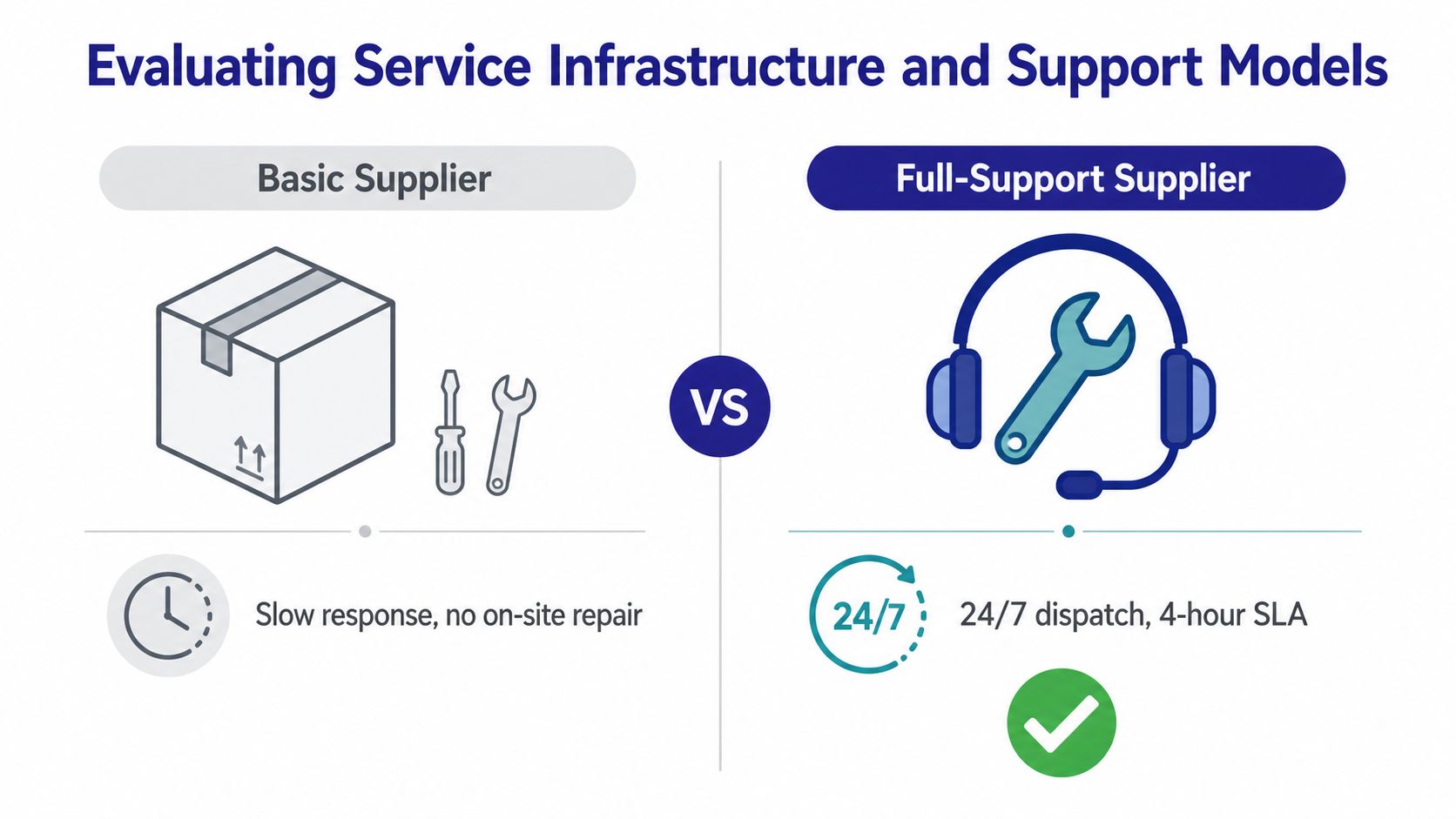
The difference between a supplier and a true support partner becomes obvious after the first breakdown. One ships equipment and hopes for the best. The other keeps stores running.
Compare what happens after installation
A transactional vendor often looks fine during bidding because the proposal is easy to read. The problem starts when a store needs help and the supplier relies on a loose third-party network with inconsistent quality. A full-support supplier usually has tighter control over dispatch, parts, and escalation.
That's why service coverage deserves the same scrutiny as the hardware spec. Procurement should check regional reach, actual response expectations, warehouse coverage for spare parts, and whether the vendor supports remote diagnostics or just phone triage. Those details decide whether a failed unit becomes a minor interruption or a full field headache.
The business case for a stronger service model is straightforward. Grocery stores operate under tight labor schedules, and technicians rarely have time to babysit vendors. A supplier with weak service infrastructure turns store teams into project managers, which is the wrong use of labor.
Ask how the supplier handles real incidents
Service promises only matter if they survive stress. That means asking the vendor what happens when:
A component fails on a weekend: Who takes the call, and who owns the dispatch?
Parts are out of stock: What substitutions are approved, and how fast?
Firmware needs a patch: Can the update be pushed centrally or only on-site?
A rollout hits multiple stores: Can the supplier prioritize based on business impact?
The video below is useful for procurement teams that want to pressure-test support assumptions before signing. It's not about product glamour, it's about understanding how service models behave when something stops working.
An owner-managed supplier with a long operating history and ISO-based processes can offer more predictable support than a vendor that subcontracts everything. For a general corporate example, systec POS-Technology GmbH's company profile shows how procurement teams can review ownership structure and operating model alongside product claims.
A warranty page alone is never enough. The service question is whether the supplier can keep equipment available without making the store team chase every fix.
Compliance Certifications and IT Integration Readiness
Modern grocery equipment isn't isolated hardware anymore. It connects to store networks, digital workflows, and, in some cases, customer-flow systems that need to be managed centrally.
Certifications matter because stores inherit the risk
Documentation such as CE, ISO, and TÜV isn't paperwork theater. It helps procurement teams reduce rollout risk, especially when equipment moves across store formats, regions, or countries. A supplier that can't produce clean documentation may still sell a functional product, but it gives the buyer less protection when the deployment gets complicated.
Integration readiness matters just as much. A gate, handle system, or trolley accessory that can't connect cleanly to existing store infrastructure can create a new silo inside the store. That's a waste of the very modernization budget that was supposed to simplify operations.
Practical rule: if equipment needs IT support, the supplier should be able to explain configuration, remote access, and update paths in plain language.
Integration is now part of the spec
Modular design becomes important. Products that support configurable components, multiple trolley generations, or mixed store formats reduce replacement pressure later. They also make it easier to retrofit instead of rebuild, which is often the only realistic path in active stores.
Security and entrance systems are a good example. Some solutions are built to connect to store networks, allow central updates, and support remote configuration during normal operations. That kind of readiness matters because store teams don't want a hardware project that closes lanes or interrupts trading.
The same logic applies to equipment that supports customer-facing digital behavior. A physical accessory that can accommodate mobile workflows, app usage, or digital order handling fits better into an omnichannel store than a static fixture that can't evolve.
The most useful evaluation question is not, “Does it work today?” It's, “Can the supplier prove the equipment will still fit the store's tech stack after the next system change?”
Building Your Supplier Evaluation Scorecard
A supplier scorecard only works if it forces real answers. The easiest way to keep vendors honest is to score what can be verified, not what sounds polished in a presentation.
Weight the criteria before the RFP goes out
A useful scorecard usually includes six buckets, lifecycle cost, technical fit, service support, compliance, integration readiness, and supplier stability. The weight of each bucket should change by store format, but the framework should stay consistent across vendors.
A practical RFP package should ask for:
Lifecycle assumptions: energy use, service intervals, parts availability, and replacement path.
Technical proof: operating specs, ambient ratings, noise levels, and load limits.
Service map: response times, coverage areas, and spare-part access.
Documentation: CE, ISO, TÜV, and any other relevant compliance records.
Integration detail: network compatibility, remote access, and update process.
Reference sites: similar store formats, not just flagship installations.
Score what can be verified
A vendor reference check should focus on store managers and facilities leads using similar equipment in similar conditions. The important questions are blunt. Did the supplier answer calls? Were parts available? Did the equipment integrate cleanly? Would the customer buy the same system again?
For teams managing cyber and supplier risk more broadly, GoSafe Dark Web monitoring for MSPs is a useful reminder that supplier risk review shouldn't stop at the technical spec, because external exposure and third-party dependencies can matter across the full operating chain.
A scorecard also needs a tie-breaker. If two suppliers look similar on paper, choose the one that reduces labor, shortens repair cycles, or simplifies future integration. That choice usually pays back faster than a small purchase-price difference.
The cleanest procurement decision is the one that the field team doesn't have to defend later. If the scorecard can't explain why a supplier won, the rollout team will end up explaining it for you.
Adapting Criteria for Different Store Formats
A chain supermarket and a rural mixed-use store should not weigh suppliers the same way. The right equipment partner depends on what the store is trying to do every day, and how much labor it has to do it.
Different formats need different priorities
Large-format stores usually care most about throughput, service depth, and integration consistency. They need suppliers that can standardize across many locations without forcing one-off exceptions. Small-format urban stores often need compact, retrofit-friendly equipment that doesn't create maintenance headaches or consume scarce floor space.
Independent rural and mixed-use stores face a different challenge. Guidance for those operators highlights the need for suppliers that reduce labor burden and support digital workflows, not just broad catalogs, especially when inflation and labor scarcity push stores toward modular, retrofit-friendly strategies (rural grocery guidance). In other words, a flexible product that works with existing operations can be more valuable than a flashy new system that needs constant attention.
A simple way to weight the scorecard
A practical allocation looks different by format:
High-volume supermarket chain: put more weight on service infrastructure, integration, and lifecycle cost.
Small-format urban store: put more weight on footprint, retrofit flexibility, and ease of maintenance.
Rural independent store: put more weight on labor reduction, modularity, and supplier responsiveness.
Mixed-use location: put more weight on adaptability, customer-flow control, and digital compatibility.
The point isn't to build a separate evaluation system for every site. The point is to adjust the same scorecard so it reflects the operating reality of the store.
A store that sells groceries plus pharmacy pickup, prepared foods, or community services will need equipment that fits multiple workflows. That usually rewards suppliers who can support modular components, service access, and digital readiness without forcing a full rebuild.
Procurement works best when it starts with store format, not catalog breadth. The supplier should fit the operation, not the other way around.
Systec POS-Technology GmbH develops shopping trolley security, handle, and accessory solutions that fit into store processes and IT systems, which makes it relevant for buyers who need more than a hardware shipment. If the goal is to compare equipment partners on lifecycle support, integration readiness, and operational fit, visit systec POS-Technology GmbH and review how its trolley and entrance solutions align with your store format and rollout plan.
Refined using the Outrank tool
Resources
Related articles


Protect your Profit
We provide professional advice on shopping cart accessories and merchandise protection.